
UPDATE: Classes will take place between April 14th and 17th, from 2 PM to 6 PM, at Hub ES+.
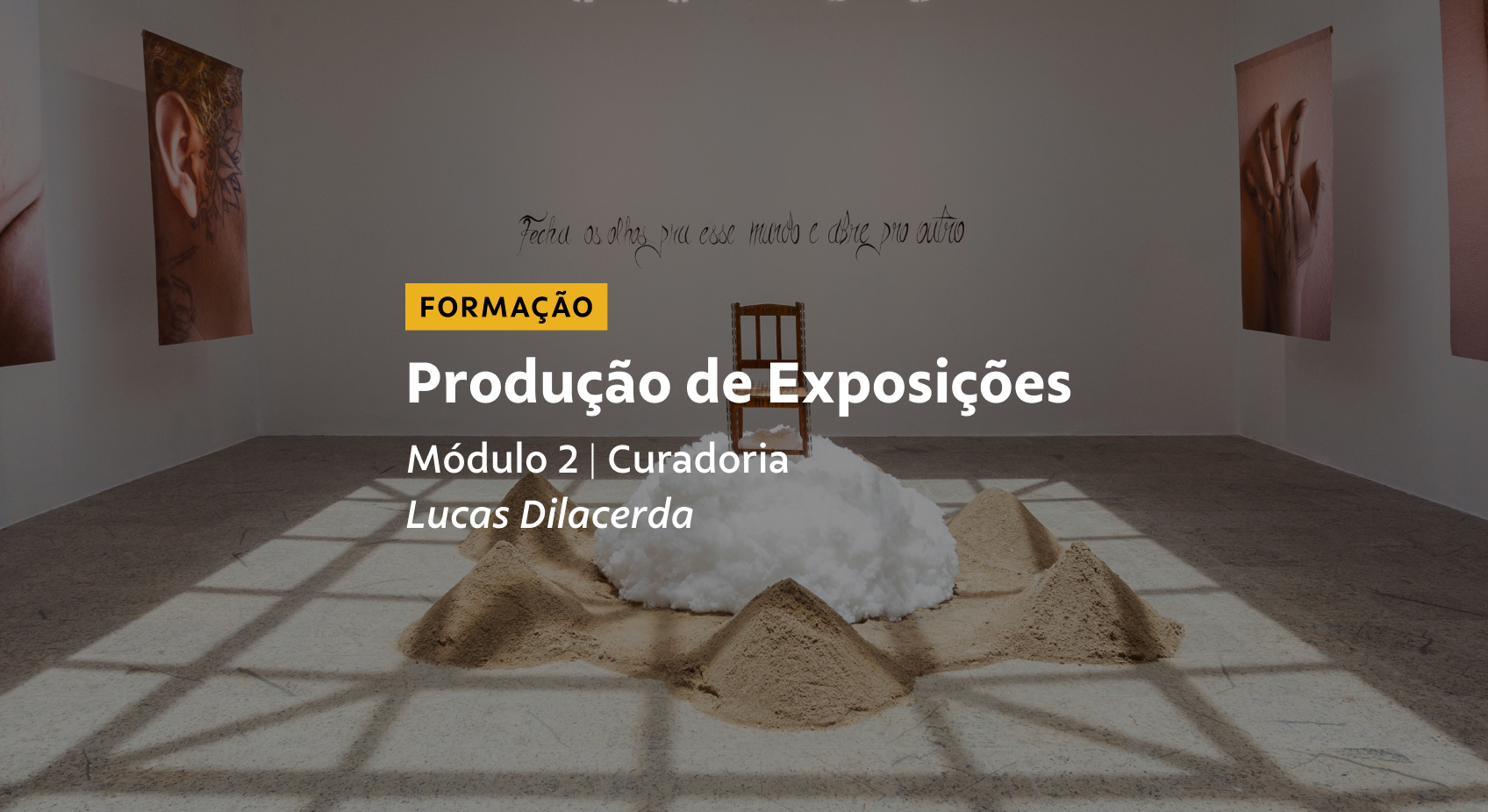
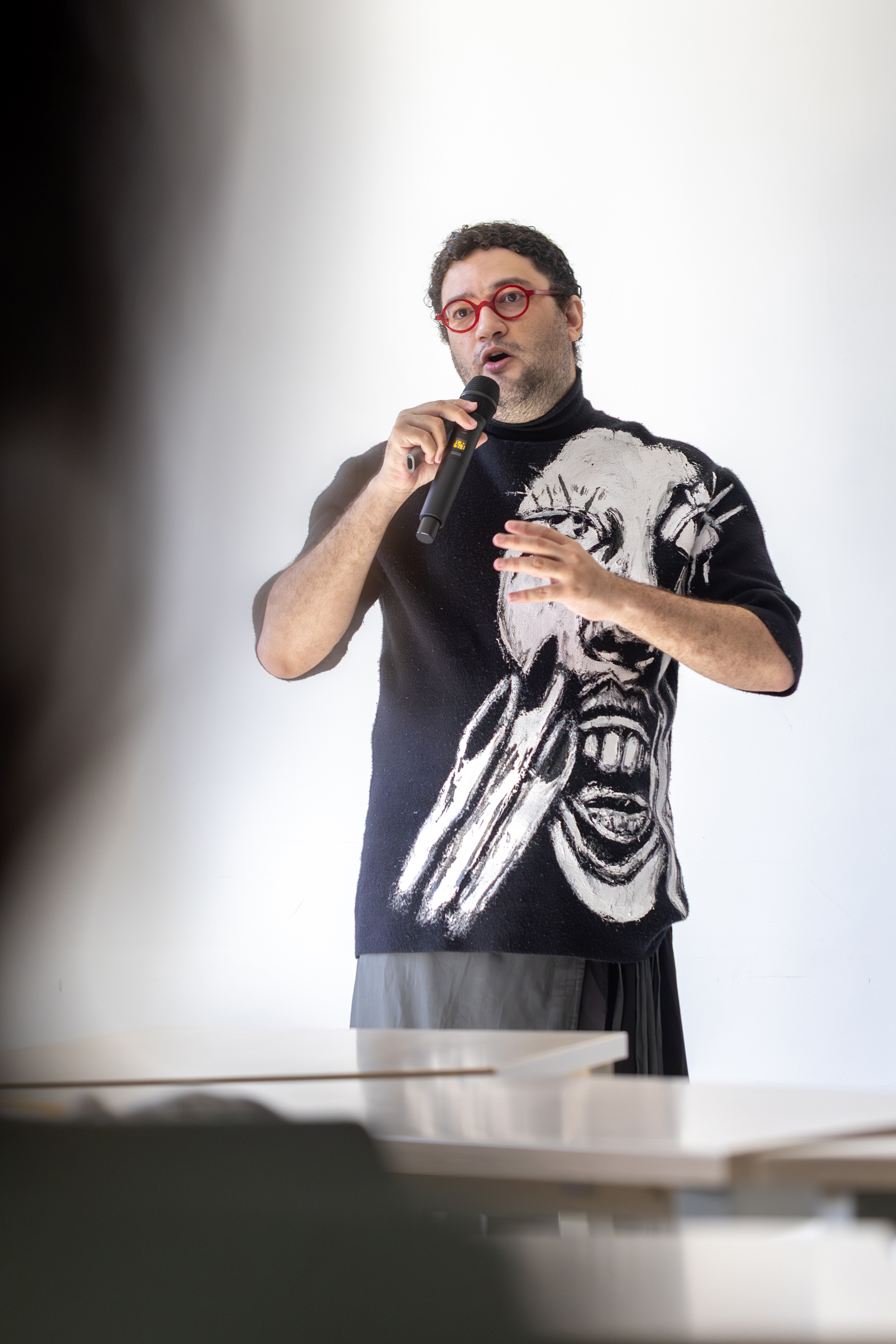
We have invited curator and art critic Lucas Dilacerda to lead the second module of the 2026 Exhibition Production Training program. This module is dedicated to understanding the phenomenon of curatorship from a historical, political, aesthetic, poetic, and methodological perspective.
Dates: April 14th to 17th | 2 PM to 6 PM | Vitória, ES
Registration closed
The course presents the process of constructing an exhibition from idea to realization, discussing the role of curatorship at each stage: theme, research, methodology, project, production, exhibition design, visual communication, and accessibility. It discusses curatorship as a constantly transforming historical phenomenon and as a political practice, reflecting on curatorial work and its commitment to building new subjectivities, imaginaries, and perceptions of the public and the community.
Summary of the course program:
Lesson 1 – History of Curatorship
This lesson presents the history of curatorship from the museums of ancient Greece, through cabinets of curiosities and art salons, to modern museums and the white cube. It shows how curatorship has moved beyond simply organizing objects to creating meaning, constructing narratives, and mediating between the artwork, the artist, and the public.
Lesson 2 – Contemporary Curatorship
This lesson presents contemporary curatorship as a political practice that constructs subjectivities and perceptions. It revisits its origins linked to care, healing, conservation, and selection, and discusses its limits with authorship. With the excess of images, it emerges as a tool for choice in the face of the crisis of sensitivity. It is conceived as a clinical practice of listening to the symptoms of the present, as magic that captures invisible dimensions of reality, as the creation of curatorial fictions, and as the assembly of archives.
Lesson 3 – Curatorial Methodology
From the idea to the realization of an exhibition. The stages are: theme, research, methodology, project, production, curatorship, registration, contracting, insurance, transportation, artwork collection, technical report, exhibition design, visual communication, accessibility, catalog, programming, seminar, educational component, and dismantling.
Lesson 4 – Curatorship and the Art System
Curatorship within the art system, covering the stages of legitimation (what is recognized as art), institutions (museums and cultural centers), galleries (representation spaces), fairs (circulation and visibility), and the art market (sales and value). How the curator gains prominence by connecting all these elements.
Lesson 5 – Curatorial Project
Each student presents their own curatorial project, explaining the idea, the chosen artists, and how they intend to organize the exhibition. The presentations will be listened to and will receive guidance, with suggestions for improvement and practical advice to strengthen the project. A moment of exchange, learning, and improvement, where they can further develop their proposal based on constructive feedback.
Who is Lucas Dilacerda?
Curator and Art Critic. He is a member of AICA – International Association of Art Critics. He was the curator of the Sertão International Biennial and won the ABCA award for the exhibition’s outstanding performance. He is a member of ABRE – Brazilian Association of Aesthetics; ABCA – Brazilian Association of Art Critics; ANPAP – National Association of Researchers in Visual Arts; and the PIPA Prize Nomination Committee.
He has curated over 70 exhibitions, published 80 texts, taught 90 courses, and given 250 presentations at various art institutions, such as Sony – Europe; Meridiano – Argentina; Pinacoteca do Ceará; Museum of Modern Art of Bahia; Goethe Institute; ECARTA, Porto Alegre; Parque Lage, Rio de Janeiro; SESC, São Paulo; etc. He holds undergraduate, master’s, and doctoral degrees in Arts; and also undergraduate and master’s degrees in Philosophy, with an emphasis on Aesthetics.
MBA in Curatorship, Museology and Exhibition Management from Estácio; Specialization in Art History from UNIUBE in Minas Gerais; and Postgraduate degree in Curatorship and Art Criticism from PUC in São Paulo.
*Free program
Initiative of the Museu Vale and the Vale Cultural Institute, sponsored by Vale, and carried out by the Ministry of Culture, via the Cultural Incentive Law.


Fale conosco
Redes sociais